Short answer: if your home was built before 1970 here in King or Pierce County, there's a real chance you're standing on original hardwood right now and just can't see it. We've pulled back carpet in Seattle, Tacoma, and all over the Puget Sound for 15 years, and the floor underneath surprises homeowners more often than not. Here's how to check for yourself without tearing anything up, what you're likely to find, and when it's worth having us take a look.
Why so many older Puget Sound homes hide hardwood
It comes down to timing. For the first half of the 20th century, hardwood was simply what you walked on. The Craftsman bungalows that fill neighborhoods like Ballard, Wallingford, Tacoma's North End, and Proctor were almost all built with real wood floors as standard. Then synthetic wall-to-wall carpet hit the mass market around 1954, and it took off fast. The carpet industry sold roughly six million square yards in 1951; by 1968 that number was approaching 400 million. Carpet was the affordable luxury of the era, and homeowners rolled it right over the wood floors they already had.
So a huge slice of our local housing stock, especially homes built pre-1970 and particularly the pre-1940 Craftsmans, has original hardwood sitting quietly under decades-old carpet and padding. The wood didn't go anywhere. It just got covered up and forgotten.
Safe DIY ways to peek without wrecking anything
You don't need to rip up a room to find out what's under there. There are several spots where you can sneak a look in five minutes, and every one of them is reversible if you're gentle. Start with the easiest and work down only as far as you need to.
- Look in a closet corner. Carpet in closets is often loosely laid or even just a remnant, and the corner is the easiest place to fold back a few inches and see the floor underneath.
- Pull a floor vent or register. Lift the metal grille out of the floor and look at the cut edge of the opening. You can usually see a clean cross-section of exactly what's down there: finish wood, subfloor, or sheet goods.
- Check a doorway transition. Where carpet meets tile, vinyl, or another room, the edge is held by a metal or wood strip. Peek under or beside that strip to glimpse the layer below.
- Lift a discreet corner near a wall. Carpet is held down by tack strips around the perimeter. In an out-of-the-way corner, grab the carpet with pliers an inch or two from the wall and pull straight up. It'll unhook from the tack strip with a little resistance.
- Press the carpet back down firmly when you're done. Step on the edge to re-seat it onto the tack strip. It'll grab again and you'll never know you looked.
What you might find, and what it actually means
Once you've got eyes on the layer under the pad, here's how to read it. There are basically three things you'll see.
- Real hardwood. Narrow tongue-and-groove boards, usually around 2 to 3 inches wide, running in long continuous strips with a tight grain. This is the jackpot: solid oak or Douglas fir that can almost always be sanded and refinished.
- Softwood subfloor. Wider, rougher planks, often laid diagonally, with visible gaps between boards. This is structural subfloor, not a finish floor. It was meant to be covered, so it's not something you'd sand and live on directly, but it does mean a new floor can go on top.
- Particleboard or plywood. A flat, uniform sheet, sometimes with a speckled or layered look at the cut edge. That tells you there's no original hardwood here, just a modern flat substrate built to carry carpet or another covering.
Clues from the house itself
Even before you lift any carpet, the house drops hints. The single biggest tell is age: a pre-1970 home, and especially a pre-1940 Craftsman, was very likely built with hardwood. Beyond the era, look for these giveaways.
- Exposed wood floors in closets, on stairs, or in a room that was never carpeted, like a back bedroom or a sun porch.
- Hardwood already visible in an adjacent room, since builders rarely switched floor materials mid-house. If the dining room has oak, the carpeted living room next door probably does too.
- Wood thresholds at doorways that sit slightly proud of the carpet, hinting at a finish floor underneath rather than bare subfloor.
- Carpet that feels like it sits high in the room, with door bottoms trimmed short, which often means it was laid right over an existing hard floor.
It looks rough. Is it ruined?
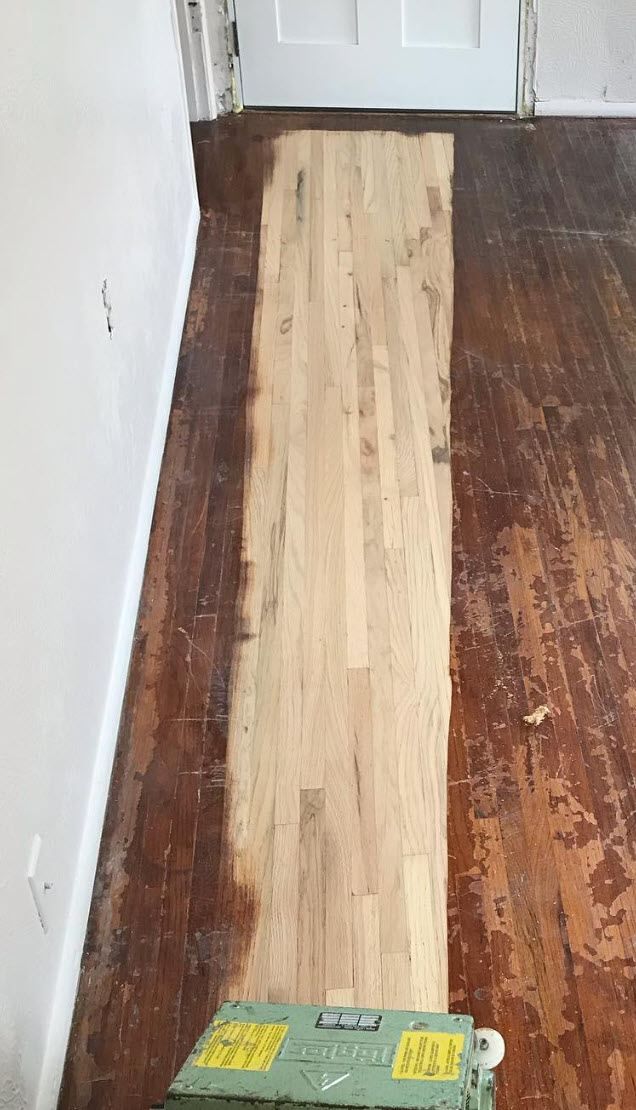
Almost never. This is the part where folks talk themselves out of a beautiful floor for no reason. When carpet comes up, the wood underneath usually looks tired, and that's completely normal. Here's what's cosmetic versus what's a real concern.
- Tack-strip nail holes along the edges of the room: cosmetic, and they sand out or hide under base trim.
- Staple and pad residue, or gummy adhesive haze: surface-level, removed during prep and sanding.
- Pet stains and dark spots: often sandable, and where they go deep, individual boards can be swapped.
- Water rings or sun fade: typically lifts with a full sand-and-refinish since you're cutting below the old surface anyway.
- Squeaks and a few cupped or loose boards: usually fixable with refastening and board repair before refinishing.
"I can't count how many Tacoma and Seattle homeowners apologized to me for how bad the floor looked, then teared up a little when they saw it finished. The carpet was the disguise. The good floor was there the whole time."
When to call us before you commit
If your peek turns up real tongue-and-groove wood and you're thinking about a remodel, that's the moment to have us out for a free assessment before you spend money on new flooring or sign off on a contractor's plan. We can confirm the species, measure the remaining wear layer to see how much life is left, check for water or subfloor issues you can't spot from a corner peek, and tell you honestly whether refinishing the original floor is the smart move or whether you're better off going another direction. It's a no-pressure look, and it can save you from carpeting or laminating over a floor that's worth restoring. Reach out and we'll come take a look and give you a straight answer and a free estimate.
Frequently Asked Questions
Start with the era: pre-1970 homes, especially pre-1940 Craftsmans, very often have hardwood. Then peek somewhere reversible, like a closet corner, under a floor vent, or by gently lifting a carpet corner near a wall with pliers. If you see narrow tongue-and-groove boards, that's real hardwood. Press the carpet back onto the tack strip when you're done.
Not if you're gentle. Carpet is held by tack strips around the room's edge, so in an out-of-the-way corner you grab the carpet with pliers an inch from the wall and pull straight up to unhook it. Wear a glove since the strip nails are sharp. When you're done, step the edge back down and it re-grips. No harm done.
Most often red or white oak, or vertical-grain Douglas fir, which is a genuine Northwest classic in early-1900s bungalows and Victorians. Oak is harder and very common from the mid-century on. Fir is a bit softer but refinishes to a warm amber that looks fantastic in vintage homes. Both can typically be sanded and brought back beautifully.
Usually yes. Tack-strip holes, staple marks, pad residue, and surface stains almost always sand out, and deep pet stains can be addressed by replacing individual boards. Solid hardwood can be sanded several times over its life, so a floor that looks rough under decades-old carpet typically has plenty of wood left. The rough look is usually just the before picture.
Wider, gappy, often diagonal planks are structural subfloor, not a finish floor, and a flat uniform sheet is plywood or particleboard. Neither is original hardwood you can refinish, but both mean a new floor can be installed on top. If you're unsure what you're looking at, send us a photo or have us out for a free assessment and we'll identify it for you.
If you've found real hardwood and a remodel is on the table, yes. Before you pay for new flooring or approve a contractor's plan, have us out for a free assessment. We'll confirm the species, measure how much wear layer is left, check for hidden subfloor or moisture issues, and tell you honestly whether restoring the original floor is the right call. It's no-pressure and can save you real money.